By Bismid Cosmetics Abuja | 25+ Years of Skincare Expertise | Updated April 2026
Quick Answer
Abuja’s shift from dry Harmattan (November–February) to hot, humid rainy season (April–October) forces your skin through two opposite extremes. Harmattan strips moisture; the rains drown your pores in heat and humidity. The skincare products that saved your skin in December will break it out in May. This guide, from Bismid Cosmetics Abuja — your 25-year skincare authority — gives you the exact products to swap, when to swap them, and why your skin needs completely different care for each season.
If you live in Abuja, you already know: the weather here does not ease you into a new season. One week you are battling cracked lips and flaky cheeks from the Harmattan dust; a few weeks later, the rains arrive with full heat and humidity, and suddenly the thick cream that was your best friend is clogging your pores and causing breakouts.
This is the skincare transition problem that most people in Abuja experience every single year — but almost nobody talks about. Generic skincare advice from international blogs is written for European or American climates. It does not account for what happens to melanin-rich skin when it moves between Abuja’s extreme dry season and its intensely humid rainy season.
After 25 years of selling and recommending skincare products to thousands of Abuja customers at our stores in Gwarinpa, Kubwa, and Wuse Market, we have seen exactly which mistakes people make, which products perform in each season, and — most importantly — how to protect your skin through the transition so it stays clear, even, and healthy all year.
This is that guide.
| TABLE OF CONTENTS |
| 1. How Abuja’s Two Seasons Affect Your Skin Differently |
| 2. Warning Signs Your Skin Needs a Season Change |
| 3. What to STOP Using When the Rains Begin |
| 4. Best Skincare Products to START Using in Abuja’s Rainy Season |
| 5. Your Step-by-Step Transition Routine (Morning & Night) |
| 6. Season Transition Skincare by Skin Type |
| 7. The Biggest Mistakes Abuja Residents Make During the Transition |
| 8. FAQ: Your Questions Answered |
| 9. Where to Buy the Right Products in Abuja |
1. How Abuja’s Two Seasons Affect Your Skin Differently
To understand which products to use, you first need to understand what each season actually does to your skin at a biological level.
The Harmattan Season (November – February)
The Harmattan is a dry, dusty trade wind that blows across West Africa from the Sahara Desert. In Abuja, it brings:
- Very low humidity (sometimes as low as 10–20%)
- Cold morning and night temperatures (as low as 9°C–15°C in some years)
- Fine dust particles in the air that settle on skin
- Harsh, moisture-stripping wind
What this does to your skin: The low humidity pulls moisture directly out of your skin’s outer layer (the stratum corneum). Without enough water in the skin cells, the skin barrier breaks down. You get dry patches, flaking, cracked lips, rough knuckles, and increased sensitivity. Dark skin is more prone to ashiness — that chalky, grey appearance caused by excessive moisture loss.
The dust particles from Harmattan winds also carry pollutants that oxidise on skin, accelerating free radical damage and dark spot formation.
The Rainy Season (April – October)
When the rains arrive, Abuja’s environment flips to the opposite extreme:
- Humidity rises to 70–90%
- Temperatures stay high (28°C–36°C) with intense UV radiation between rain showers
- Sweat production increases significantly
- Skin surface becomes constantly damp
What this does to your skin: High humidity means the skin does not lose moisture as quickly — but it also means sebum (natural skin oil) production increases. Your pores are already producing more oil in the heat. Combined with the heavy Harmattan creams most people forget to change, this creates a perfect environment for clogged pores, acne breakouts, fungal infections, and exacerbated hyperpigmentation.
The Transition Period (March – April): When Skin Suffers Most
The weeks between the end of Harmattan and the arrival of steady rains are unpredictable. One day is dry and dusty; the next is humid and sweaty. This instability is when the most skin complaints arrive at our Abuja stores. Your skincare routine needs to adapt before the rains fully arrive — not after your skin has already broken out.
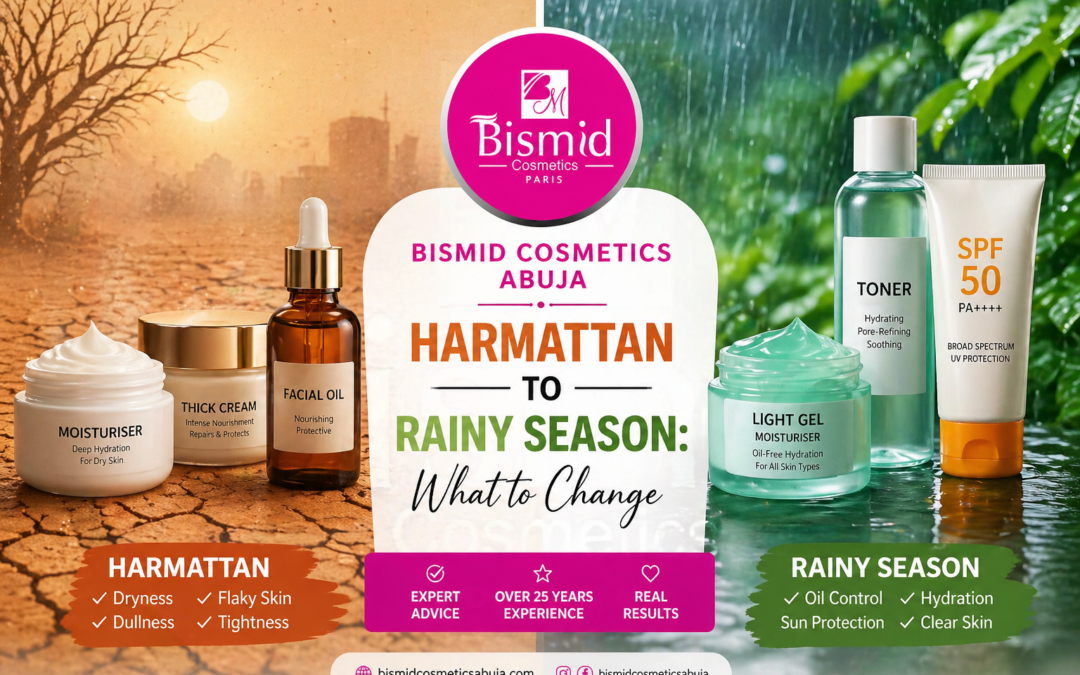
| Harmattan (Nov–Feb): What your skin needs | Rainy Season (Apr–Oct): What your skin needs |
| Rich, occlusive moisturiser to seal in water | Lightweight, water-based gel moisturiser |
| Heavy facial oils to restore the skin barrier | Oil-free or very light facial serum |
| Cream or balm cleanser (gentle, non-stripping) | Foaming or gel cleanser (removes excess oil) |
| Humectant-rich products (glycerin, hyaluronic acid) | Niacinamide toner (controls sebum production) |
| Barrier-repair products (ceramides, shea butter) | Non-comedogenic SPF (will not clog pores) |
| Weekly gentle exfoliation to remove flake build-up | Regular exfoliation to prevent pore congestion |
| Hydrating sheet or cream mask 2x per week | Clay mask 1x per week to purify pores |
2. Warning Signs Your Skin Is Telling You to Change Products
Your skin gives you signals when the season has changed and your routine has not kept up. If you are experiencing any of the following during the transition period, it is time to switch:
| SIGNS YOU NEED TO SWITCH TO RAINY SEASON PRODUCTS |
| Sudden breakouts on skin that was clear all Harmattan |
| Skin feeling greasy or sticky within an hour of applying moisturiser |
| Clogged pores or blackheads appearing especially on nose and forehead |
| Increased sweating that sits on the skin surface instead of evaporating |
| Existing dark spots appearing darker or more noticeable |
| Skin feeling congested or heavy despite no visible spots yet |
| Makeup not sitting properly or melting off faster than usual |
3. What to STOP Using When the Rains Begin
Knowing what to put down is just as important as knowing what to pick up. These are the product types that work beautifully in Harmattan but actively harm your skin once Abuja’s humidity rises.
Heavy Body Butters and Thick Creams
Products rich in shea butter, cocoa butter, and petroleum jelly are excellent occlusive agents — they form a physical barrier that prevents water from escaping the skin in Harmattan’s dry air. In high humidity, however, that same barrier traps heat, sweat, and bacteria against your skin. Body bumps, heat rash, and back acne are common results.
What to do: Move your heavy body butter to a small tub and use it only on very dry areas like elbows, knees, and feet. Replace your all-over body product with a lighter lotion.
Thick, Cream-Based Facial Moisturisers
The same logic applies to your face. A moisturiser with a thick, creamy consistency that was perfect for your dry Harmattan skin will now sit on top of your skin in the humidity instead of absorbing. Your pores cannot breathe, sebum builds up underneath, and breakouts follow within days.
What to do: Swap your cream moisturiser for a gel or gel-cream hybrid formula. Look for “water-based,” “oil-free,” or “non-comedogenic” on the label.
Oil-Heavy Cleansers and Balm Cleansers
Balm and oil cleansers are excellent for Harmattan because they clean without stripping. But in the rainy season, your skin is already producing more oil. Adding more oil in your cleanser means you start every skincare routine from a disadvantaged position.
What to do: Switch to a gentle foaming cleanser or a gel cleanser. Gentle is still important — harsh cleansers will strip the skin, triggering rebound oil production.
Rich, Nourishing Facial Oils Applied All Over
Facial oils are deeply repairing for the compromised skin barrier caused by Harmattan dryness. Once humidity rises, applying a facial oil all over your face adds to an already-oily environment. The result is congestion and clogged pores, especially on the T-zone.
What to do: If you love facial oils, keep them as a targeted treatment for dry patches only, or use them only at night in very small amounts mixed with your lightweight moisturiser.
4. Best Skincare Products to Start Using in Abuja’s Rainy Season
These are the product categories and specific product types that work best for Nigerian skin in Abuja’s humid, high-UV rainy season. All of these categories are available at Bismid Cosmetics Abuja.
4.1 Lightweight Gel Moisturiser
Your most important rainy season swap. A gel moisturiser delivers hydration (it still contains humectants like hyaluronic acid or glycerin) without the heavy occlusive layer. It absorbs quickly, does not block pores, and keeps skin comfortable in heat and humidity without a greasy finish.
What to look for: Water-listed first in ingredients, hyaluronic acid, glycerin, aloe vera, niacinamide. Fragrance-free is ideal for Abuja’s heat, which can make fragranced products irritating.
4.2 Oil-Control Toner or Niacinamide Toner
A toner is one of the most underused products in Nigerian skincare routines. In the rainy season, an oil-control toner is genuinely transformative. Niacinamide (Vitamin B3) has been clinically proven to reduce sebum production, minimise pore appearance, and fade dark spots — all of which are major concerns during Abuja’s humid months.
What to look for: 2–10% niacinamide, zinc, salicylic acid (for acne-prone skin). Avoid alcohol-heavy toners that strip the skin.
4.3 Vitamin C Serum
The rainy season in Abuja brings intense bursts of UV radiation during breaks in the cloud cover. This UV exposure, combined with the heat-driven inflammation already present in humid weather, accelerates hyperpigmentation and uneven skin tone. A daily Vitamin C serum applied in the morning neutralises free radicals from UV exposure before they cause dark spots, brightens existing hyperpigmentation, and boosts the effectiveness of your sunscreen.
What to look for: 10–20% L-ascorbic acid (the most effective form), or more stable derivatives like Ascorbyl Glucoside or Sodium Ascorbyl Phosphate. Always store Vitamin C serums away from direct sunlight.
4.4 Daily Non-Comedogenic SPF 30–50+
If there is one non-negotiable for Abuja’s rainy season, it is sunscreen. UV radiation in Nigeria does not reduce when clouds appear. UVA and UVB rays penetrate cloud cover and cause damage that builds cumulatively over time: deeper dark spots, accelerated ageing, uneven skin tone, and — in extreme cases — increased risk of skin cancer.
The most common reason people skip sunscreen in the rainy season is that their Harmattan SPF was too heavy, too white-casting, or too greasy. The solution is a rainy-season-appropriate SPF: lightweight, non-comedogenic, invisible on dark skin tones.
What to look for: SPF 30 minimum (SPF 50 preferred for Abuja’s sun intensity), labelled “broad spectrum,” non-comedogenic, suitable for dark skin (no white cast). Bismid stocks several SPF options specifically tested for Nigerian skin tones.
4.5 Gentle Foaming or Gel Cleanser
Your cleanser sets up every step that follows. In the rainy season, your cleanser needs to remove excess oil, sweat, and environmental pollutants (Abuja’s rainy season still carries dust and pollution) without stripping the skin’s natural barrier. Over-stripping triggers more oil production — exactly what you are trying to avoid.
What to look for: Gentle foaming formula, pH-balanced (ideally 4.5–5.5), free of harsh sulphates like Sodium Lauryl Sulphate (SLS). Salicylic acid cleansers work well for oily and acne-prone skin types.
4.6 Exfoliating Product (Chemical Preferred)
The combination of heat, humidity, sweat, and increased sebum in the rainy season means dead skin cells accumulate faster on the surface. Regular exfoliation prevents congestion, keeps skin texture smooth, and allows your other products to penetrate and work properly.
Chemical exfoliants (AHAs and BHAs) are gentler and more effective for Nigerian skin than physical scrubs, which can cause micro-tears and worsen hyperpigmentation. Glycolic acid and lactic acid (AHAs) work on the skin surface. Salicylic acid (BHA) penetrates into pores — ideal for oily and acne-prone skin types.
How often: 1–3 times per week, always at night, always followed by SPF the next morning.
4.7 Clay or Charcoal Mask (Once Weekly)
A weekly clay mask is an excellent rainy season addition for anyone with oily, combination, or congestion-prone skin in Abuja. Clay absorbs excess sebum from deep within pores, reduces the appearance of large pores, and removes impurities that accumulate in humid conditions. Use it once per week, not more — overuse can dry out the skin and cause rebound oiliness.
| Product / Type | What it does | Why you need it now |
| Thick cream moisturiser | Seals in hydration during dry Harmattan | Replace with lightweight gel moisturiser in the rains |
| Oil/balm cleanser | Gently dissolves Harmattan dust & pollution | Swap for gentle foaming or gel cleanser |
| Heavy facial oil (all over) | Repairs damaged skin barrier in dry air | Use only as spot treatment or night treatment only |
| Hydrating cream mask | Intense moisture boost for dry Harmattan skin | Replace with clay/charcoal mask to purify pores |
| Niacinamide toner | Suitable all year — keep using this | Continue: controls oil and fades dark spots |
| Vitamin C serum | Anti-oxidant protection from Harmattan dust | Continue and intensify: fights rainy season UV damage |
| SPF (any formula) | Year-round non-negotiable | Switch to lighter, gel-formula SPF if current one feels heavy |
5. Your Step-by-Step Transition Routine (Morning & Night)
Below is the complete routine recommended by our skincare experts at Bismid Cosmetics Abuja for the Harmattan-to-rainy season transition period and through the rainy season. Adapt it to your specific skin type using Section 6.
| MORNING ROUTINE — RAINY SEASON |
| Step 1: Cleanse |
| Use your gentle gel or foaming cleanser. In the morning, a thorough but gentle cleanse removes overnight sweat and sebum that accumulated during sleep. Rinse with cool water — hot water removes too much of the skin’s natural oil barrier. |
| Step 2: Tone |
| Apply your niacinamide or oil-control toner on a cotton pad or press it into the skin with clean hands. Allow it to absorb for 30–60 seconds before the next step. |
| Step 3: Vitamin C Serum |
| Apply 3–5 drops of your Vitamin C serum and press into skin. This is your anti-oxidant armour for the day. It must go on before moisturiser and SPF to work at its full capacity. |
| Step 4: Lightweight Gel Moisturiser |
| Apply a small amount — a pea-to-almond sized amount is usually enough in the humidity. Focus on drier areas if your skin is combination type. |
| Step 5: Sunscreen SPF 30–50+ (NEVER SKIP) |
| The final and most critical step. Apply generously — most people use far too little. For the face alone, you need approximately 1/4 teaspoon (1.25ml). Allow 5 minutes before makeup application. |
| NIGHT ROUTINE — RAINY SEASON |
| Step 1: Double Cleanse (on makeup days) |
| If you wear makeup or heavy SPF: start with a micellar water or gentle cleansing oil to remove product, then follow with your gel or foaming cleanser. On no-makeup days, one gentle cleanse is sufficient. |
| Step 2: Exfoliate (2–3 nights per week only) |
| On exfoliation nights, apply your AHA or BHA exfoliant after cleansing. Allow 15–20 minutes before the next step and do not use with retinoids on the same night. |
| Step 3: Tone |
| Same niacinamide toner as morning. The second application helps control overnight sebum production. |
| Step 4: Treatment Serum |
| This is where you address specific concerns: a hyperpigmentation serum, a brightening serum, or a targeted acne treatment. Night is when the skin repairs itself — your active treatments work harder now. |
| Step 5: Lightweight Night Moisturiser or Gel Moisturiser |
| In the rainy season, your daytime gel moisturiser can double as a night moisturiser. If your skin is very dry even in the humidity, add a thin layer of a light facial oil only to dry patches before your moisturiser. |
| Step 6: Weekly Clay Mask (replace toner + serum steps) |
| Once per week, replace steps 3 and 4 with a clay or charcoal mask. Apply to the face, leave for 10–15 minutes, rinse well with cool water, then apply your moisturiser. |
6. Season Transition Skincare by Skin Type
The same Abuja climate affects different skin types differently. Here is how to adapt the transition recommendations above to your specific skin type.
Oily Skin in Abuja’s Rainy Season
You will notice the most dramatic change when the rains begin. Your skin, which was finally balanced in Harmattan, suddenly becomes excessively oily and prone to breakouts. Your priority is oil control without over-stripping.
- Use a salicylic acid cleanser (0.5–2%) once daily, alternating with a gentle non-BHA cleanser
- Choose a 10% niacinamide toner — the higher concentration controls sebum more effectively
- Skip facial oils entirely during the rainy season
- Exfoliate with a BHA (salicylic acid) 2–3 times per week
- Opt for a completely mattifying, oil-free moisturiser
- Use clay mask twice per week rather than once
Dry Skin in Abuja’s Rainy Season
Even with high humidity, dry skin types may not feel as oily as others. But the common mistake is keeping the heavy Harmattan routine unchanged. The humidity means you need less occlusion — but you still need hydration.
- Move from cream to a gel-cream moisturiser (not a purely gel formula — gel-cream gives hydration with some barrier support)
- Continue using hyaluronic acid and glycerin-rich products
- AHA exfoliation once per week is sufficient
- You can continue a light facial oil at night on dry patches only
- Never skip SPF — dry skin types are especially prone to UV-triggered dark spots
Combination Skin in Abuja’s Rainy Season
Combination skin faces the most complex transition. Your T-zone (forehead, nose, chin) will behave like oily skin in the humidity; your cheeks may remain balanced or even feel slightly dry at first.
- Use different products on different zones: gel moisturiser on the T-zone, gel-cream on the cheeks
- Apply clay mask only on the T-zone once per week; skip the cheeks
- Niacinamide toner all over the face helps unify the skin behaviour
- Use BHA exfoliation on the T-zone only; AHA if needed on the cheeks
Acne-Prone Skin in Abuja’s Rainy Season
The rainy season is peak acne season in Abuja for skin already prone to breakouts. The transition from Harmattan to rainy season is when we see the most acne cases at our stores. Start switching your products in March, before the rains fully arrive, to prevent the typical rainy-season breakout cycle.
- Salicylic acid cleanser twice daily (morning and night)
- Niacinamide toner: use both morning and night without exception
- Non-comedogenic SPF is critical — sunscreen that clogs pores will worsen acne significantly
- Avoid ALL heavy creams, butters, and oils on the face
- A benzoyl peroxide treatment (2.5–5%) used as a spot treatment at night helps clear active breakouts
- Visit Bismid Cosmetics Abuja for a free skin consultation if your acne does not respond to product changes within 3–4 weeks
Sensitive Skin in Abuja’s Rainy Season
The transition period — when weather is unpredictable — is especially hard on sensitive skin. The fluctuating temperature and humidity trigger redness, irritation, and flares for those with reactive skin.
- Introduce new rainy season products one at a time, with 3–5 days between each introduction
- Choose fragrance-free formulas in every product category
- Avoid active ingredients (AHAs, BHAs, Vitamin C) in the same routine until skin is settled
- Use a physical (mineral) sunscreen rather than chemical SPF — less likely to cause irritation
- Centella asiatica and panthenol-containing products are excellent calming ingredients for the transition period
7. The Biggest Mistakes Abuja Residents Make During the Transition
After 25 years in the skincare business in Abuja, these are the mistakes we see most frequently — and the ones that cause the most preventable skin damage.
| MISTAKE 1: Waiting for breakouts before changing products |
| By the time your skin breaks out, the problem has already been building for weeks. Transition your routine proactively in March, as soon as the dust begins to settle and daytime temperatures start to feel more humid. Do not wait for the damage. |
| MISTAKE 2: Thinking sunscreen is only for sunshine |
| UV radiation is present every day, including cloudy and rainy days. Many Abuja residents only wear SPF when the sun is visibly bright. The result is months of cumulative UV damage during the rainy season that manifests as darker hyperpigmentation and uneven skin tone. SPF is every day, all year. |
| MISTAKE 3: Buying counterfeit or unregulated products to solve seasonal breakouts |
| When rainy season breakouts arrive, many people in Abuja turn to cheap roadside products promising fast clearing. These often contain unregulated levels of hydroquinone, steroids, and harsh acids that damage melanin-rich skin permanently. Always buy from a verified retailer. At Bismid Cosmetics Abuja, every product we sell is original, verified, and sourced from authorised suppliers. |
| MISTAKE 4: Over-washing the face to control oiliness |
| When skin feels greasy in the rainy season humidity, the instinct is to wash the face more frequently. But washing more than twice daily strips the natural moisture barrier. The skin responds by producing even more oil to compensate. Twice daily cleansing is the maximum. Use blotting paper between washes if needed. |
| MISTAKE 5: Using too many active ingredients at once during the transition |
| Vitamin C, niacinamide, AHA, BHA, and retinol are all excellent ingredients. Used all at once during a period when your skin is already adjusting to a new climate, they create overload that causes irritation, purging, and sensitivity. Introduce one new product at a time during the transition period. Build your rainy season routine gradually. |
8. Frequently Asked Questions
These questions are set up as FAQ schema in Rank Math — see the SEO Setup Sheet on Page 1.
How does Abuja’s weather change from Harmattan to rainy season?
Abuja experiences two dramatically different weather phases. The Harmattan (roughly November to February) brings dry, dusty, cold winds that strip moisture from the skin. The rainy season (April to October) brings heat, high humidity, and heavy rainfall. Both extremes stress the skin differently and require different skincare products to maintain a healthy, clear complexion.
Why does my skin break out when the rainy season starts in Abuja?
Many people keep using their thick Harmattan moisturisers when the rains begin. Heavy creams that were perfect for protecting dry Harmattan skin now trap heat and sebum in Abuja’s humid air, clogging pores and triggering breakouts. Switching to a lightweight gel moisturiser and an oil-control toner as soon as the rains arrive prevents this.
What skincare products should I use during Abuja’s rainy season?
During Abuja’s rainy season, switch to lightweight, water-based moisturisers, a gentle foaming or gel cleanser, an oil-control or niacinamide toner, a non-comedogenic SPF 30–50, and a Vitamin C serum for hyperpigmentation caused by increased sun exposure. Visit Bismid Cosmetics Abuja in Gwarinpa, Kubwa, or Wuse Market for a free skin consultation and personalised product recommendations.
Do I still need sunscreen during Abuja’s rainy season?
Yes — absolutely. UV radiation in Abuja does not reduce during the rainy season. Clouds filter visible light but not UVA and UVB rays. Many people develop more hyperpigmentation during the rains because the brief sunshine between storms hits unprotected skin at peak intensity. Use SPF 30 minimum daily, every day, throughout the year.
How do I know my skin type before choosing seasonal skincare products in Abuja?
Visit Bismid Cosmetics Abuja for a free expert skin consultation at any of our three stores — Gwarinpa, Kubwa, or Wuse Market. Our skincare experts with over 25 years of experience will assess your skin type and recommend the exact products you need for the current season. You can also reach us on WhatsApp at +2348098000043.
9. Where to Buy the Right Skincare Products in Abuja
Finding original, dermatologist-approved skincare products that are appropriate for the season — and for Nigerian skin — is not always easy in Abuja’s saturated market. Counterfeit and substandard products are everywhere, and the wrong product in the wrong season can cause significant skin damage.
Bismid Cosmetics Abuja has been Abuja’s most trusted skincare authority for 25 years. As the sole authorised distributor of Bismid Cosmetics in Abuja, and a verified retailer of multiple dermatologist-approved international and Nigerian brands, every product in our stores and on our website is 100% original and season-appropriate.
| VISIT ANY OF OUR 3 ABUJA STORES |
| Gwarinpa: Suite 3, 10-Q Plaza, 3rd Avenue, Gwarinpa, Abuja |
| Kubwa: Suite 2, Princecam Plaza, Kubwa, Abuja |
| Wuse Market: B30 Shop 2, Wuse Market, Abuja |
| Free skin consultation available at all three stores with our expert team. |
| Same-day delivery within Abuja for orders placed before 4pm. |
| WhatsApp: +2348098000043 | bismidcosmeticsabuja.com |
Whether you are in Gwarinpa, Kubwa, Wuse Market, Maitama, Garki, Lugbe, or anywhere in the FCT, our stores and our online shop are your guaranteed source for original, safe skincare products for every season.
Not sure which specific products to choose for your skin type and the current season? Our experts give free, personalised skincare consultations in-store and via WhatsApp. We have helped thousands of Abuja residents achieve and maintain healthy skin through every Harmattan and every rainy season — we can help you too.
| THE BOTTOM LINE |
| Abuja’s Harmattan-to-rainy season transition is a genuine skin health event. Your skin goes from battling dryness to managing excess oil and UV damage within a matter of weeks. The solution is not expensive — it is a strategic swap of 3–4 products and a commitment to daily SPF. Start transitioning your routine in March, not when the breakouts arrive. |
| Bismid Cosmetics Abuja — Sole distributor of Bismid Cosmetics in Abuja | 25 Years of Skincare Expertise |
| bismidcosmeticsabuja.com | +2348098000043 |